

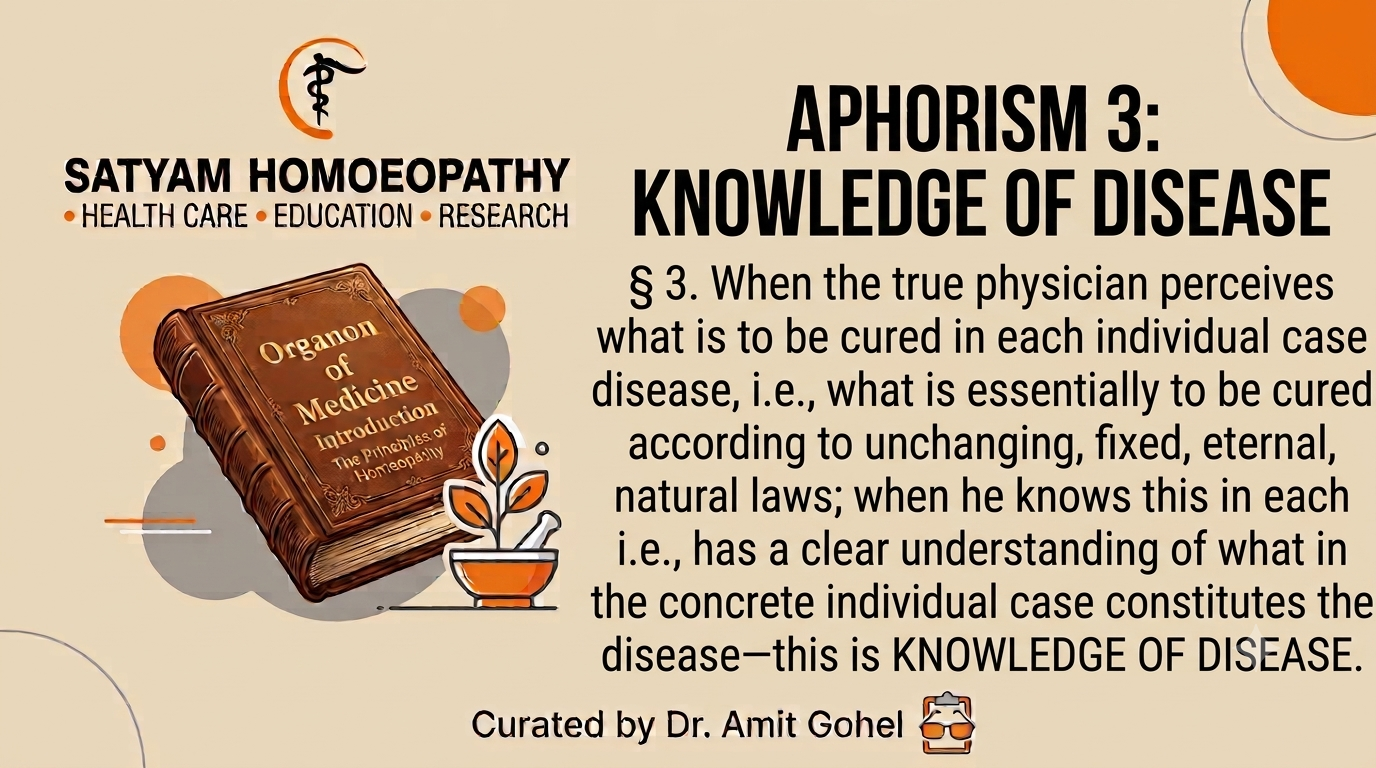
Aphorism 3:
The True Practitioner’s Roadmap: Hahnemann’s Four Pillars of Healing
In Aphorism 1, Samuel Hahnemann defined the physician’s mission (to cure), and in Aphorism 2, he set the standard (rapid, gentle, and permanent). In Aphorism 3, he provides the practical roadmap. He outlines exactly what a physician must master to transition from a “system-monger” to a “true practitioner of the healing art”.
To achieve a rational cure, Hahnemann insists that a physician must possess four distinct areas of knowledge and the skill to unite them.
-
Knowledge of the Disease (The Indication)
The first requirement is that the physician must “clearly perceive what is to be cured in diseases” in every individual case. This goes beyond simply naming a malady. Hahnemann argues elsewhere that a name like “dropsy” or “typhus” is a “useless” and “misused” label that ignores the unique reality of the patient. The “true and only conceivable portrait of the disease” is found in the totality of symptoms—the perceptible signs and deviations from health felt by the patient and observed by those around them.
-
Knowledge of Medical Powers
Secondly, the physician must “clearly perceive what is curative in medicines”. A practitioner cannot rely on “guesswork” or “theoretical webs”. Instead, they must have a precise understanding of the pathogenetic power of each individual medicine, learned through “pure experiments” on healthy persons. Without this “knowledge of medical powers,” the physician is like a person trying to create art with tools they do not understand, risking the destruction of the very thing they wish to fix.
-
The Art of Adaptation
Knowing the disease and knowing the medicine is not enough; the physician must know how to unite them according to “clearly defined principles”. This adaptation involves three critical steps:
- The Choice of the Remedy: Selecting the “medicine indicated” based on its “suitability” to the case.
- The Proper Dose: Preparing the medicine in the “exact mode” and “quantity” required. Hahnemann stresses that even a well-chosen remedy can prove “injurious” if the dose is too large for the patient’s sensitive vital force.
- The Period of Repetition: Determining the “proper period for repeating the dose” to ensure the cure continues without interruption or “untoward reactions”.
-
Removing Obstacles to Recovery
Finally, a true practitioner must understand “the obstacles to recovery in each case” and know how to remove them. Hahnemann recognized that a cure could be “overwhelmed and extinguished” by external factors. This includes everything from a “persistent unhealthy mode of living” to “injurious liquors,” “medicinal spices,” or even “subjects of anger, grief or vexation”. A physician is only a “preserver of health” if they can identify these “things that derange health” and teach the patient how to avoid them.
Conclusion: The Science of Certainty
For Hahnemann, medicine was never meant to be a collection of “empty speculations” or “learned-sounding prating”. Aphorism 3 establishes medicine as a “science of certainty”. When a physician masters the knowledge of disease, the power of medicines, the art of adaptation, and the removal of obstacles, they finally understand how to treat “judiciously and rationally”. Only then, Hahnemann concludes, can they be called a true practitioner of the healing art.

