

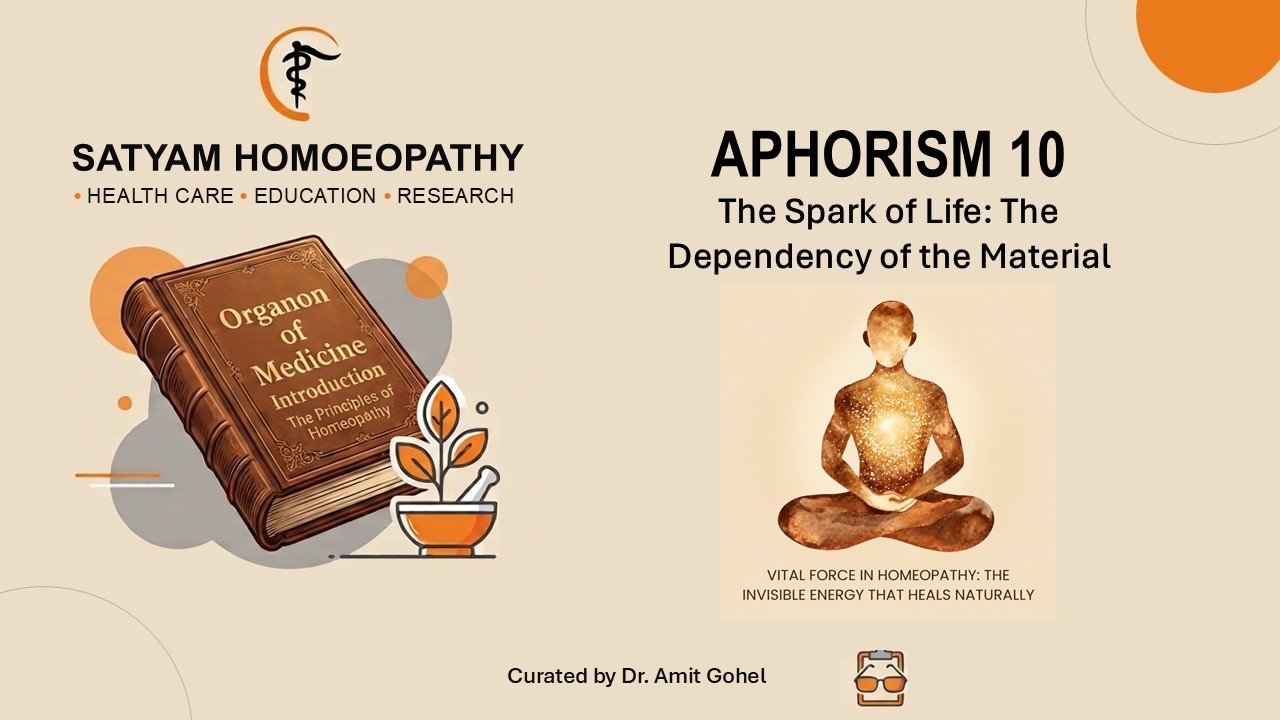
Aphorism 10:
The Spark of Life: Aphorism 10 and the Dependency of the Material Organism
In Aphorism 9, Samuel Hahnemann introduced the spiritual vital force as the invisible conductor of health. In Aphorism 10, he deepens this concept by explaining that without this animating power, the material body is nothing more than inert matter. This principle establishes the absolute dependency of our physical being on the dynamic vital principle.
The Three Pillars of the Living Organism
Hahnemann asserts that the material organism is incapable of three essential life processes without the vital force:
- Sensation: The ability to feel and perceive the world.
- Function: The active operation of organs and systems.
- Self-Preservation: The inherent power of the body to maintain its integrity and resist destruction.
He makes it clear that the body “derives all sensation and performs all the functions of life solely by means of the immaterial being” which animates it in both health and disease. The physical body is merely the instrument; the vital force is the musician that brings it to life.
The Definition of Death
Aphorism 10 provides a stark definition of death from the homoeopathic perspective. Without the animating, spirit-like power, the organism is “dead”. Once the vital force departs, the body is no longer governed by the laws of biology and harmony but falls entirely under the “power of the external physical world”.
In this state, the body:
- Loses its ability to resist external forces.
- Begins the process of decay.
- Is ultimately “resolved into its chemical constituents”.
A Rejection of Materialism
This aphorism serves as a direct challenge to the materialistic medical views of Hahnemann’s time, which often treated the body as a machine or a collection of chemical reactions. By showing that the very existence of a living person depends on a dynamic, non-material force, Hahnemann argues that medicine cannot focus on chemistry or mechanics alone.
If the body only has sensation and function through the vital force, then disease—which is a disturbance of those sensations and functions—must be a derangement of that force, not just a physical or chemical error in the organs.
Conclusion: Treating the Being, Not the Matter
Aphorism 10 reminds the practitioner that the patient is far more than their “chemical constituents”. A true cure must address the immaterial being that keeps the organism from decaying. In the homoeopathic system, the goal is not to chemically manipulate the material parts of the body, but to restore harmony to the dynamic force that allows the body to live, feel, and function.

