

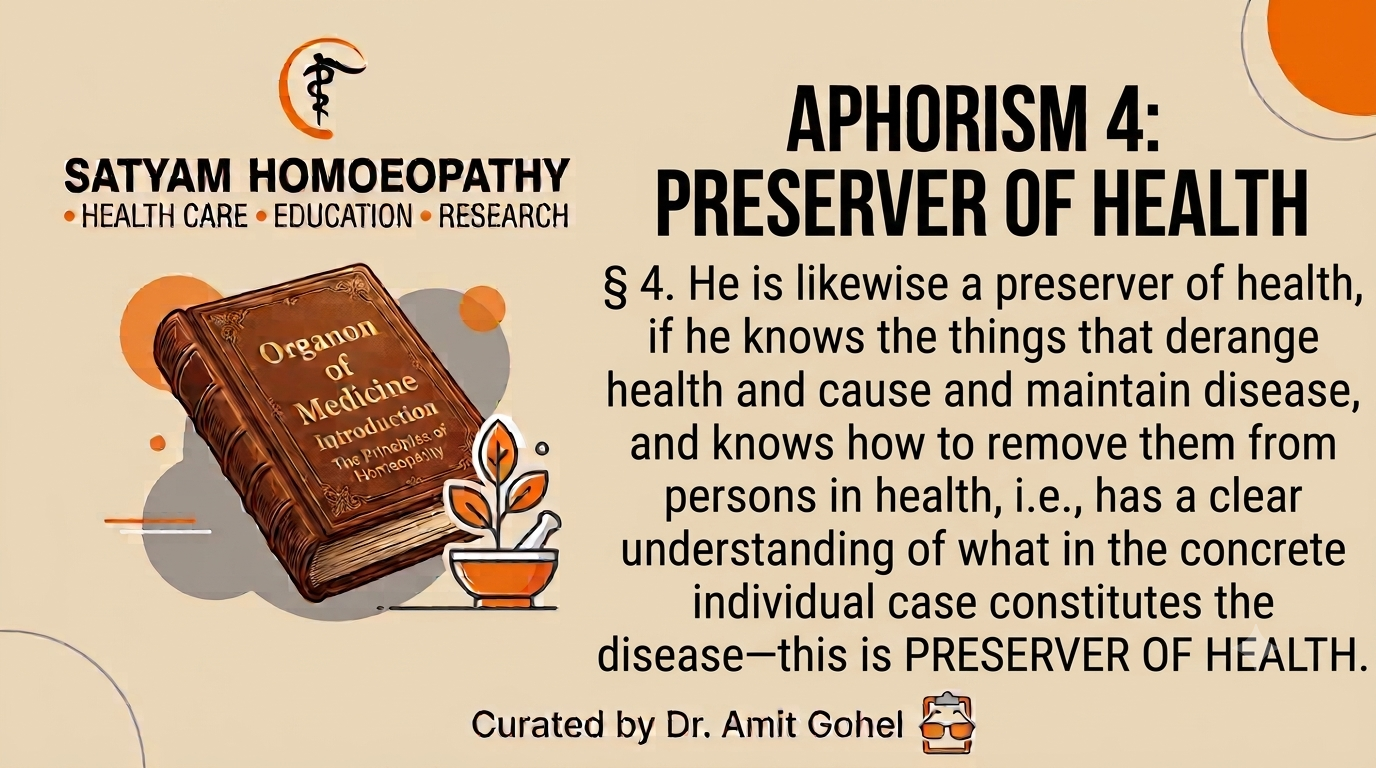
Aphorism 4:
The Physician as Guardian: Aphorism 4 and the Art of Preserving Health
While the opening principles of the Organon of Medicine focus on the physician’s mission to restore the sick to health, Aphorism 4 introduces a second, equally vital responsibility. Hahnemann asserts that a true practitioner must be more than a healer of disease; they must also be a “preserver of health”.
The Dual Mission: Healer and Protector
Aphorism 4 is succinct but profound: “He is likewise a preserver of health if he knows the things that derange health and cause disease, and how to remove them from persons in health”.
This principle marks a shift from reactive treatment to proactive prevention. Hahnemann suggests that the physician’s expertise is required even when a patient is not yet suffering from a “spirit-like (dynamic) derangement” of their vital force. To be a complete practitioner, one must understand both how to restore health and how to maintain it.
Identifying the “Derangers” of Health
To fulfill the role of a preserver, a physician must have a keen eye for the “things that derange health.” Throughout his work, Hahnemann identifies numerous “avoidable noxious influences” and “morbific noxious agents” that can lead to disease if left unchecked:
- Dietary and Lifestyle Errors: The use of “injurious liquors or aliments,” “dissipation,” or an “unhealthy mode of living”.
- Environmental Factors: Residing in “unhealthy localities,” “marshy districts,” or “confined dwellings” like cellars.
- Physical and Mental Stress: “Over-exertion of body or mind,” “subjects of anger, grief or vexation,” or even a “sedentary life in close apartments”.
- Hygienic Neglect: Factors such as “uncleanliness” or “prolonged abstinence from things that are necessary for the support of life”.
The Proactive Duty of Removal
Hahnemann emphasizes that the physician must not only identify these factors but must also understand “how to remove them”. This is often the first step in any rational treatment. Before even administering a homoeopathic remedy, a “judicious” physician should investigate the “obstacles to recovery”.
In cases of “trivial symptoms,” Hahnemann notes that a “slight alteration in the diet and regimen will usually suffice to dispel” the indisposition without the need for medicine. By teaching “persons in health” to avoid things like “medicinal spices,” “perfumes,” or “heated rooms,” the physician prevents these “foreign medicinal irritants” from overwhelming the body’s natural state.
Conclusion: A Holistic Vision of Care
Aphorism 4 reminds us that the healing art is a comprehensive science of life. The physician’s duty is not limited to the “annihilation of the disease” but extends to the guardianship of the patient’s well-being.
By mastering the knowledge of what deranges health and having the wisdom to remove those influences, the physician acts as a “preserver,” ensuring that the “harmonious, vital operation” of the organism remains undisturbed. In Hahnemann’s vision, the best medicine is that which understands how to keep the human being in a state where the “indwelling, reason-gifted mind can freely employ this living, healthy instrument for the higher purpose of our existence”.

