

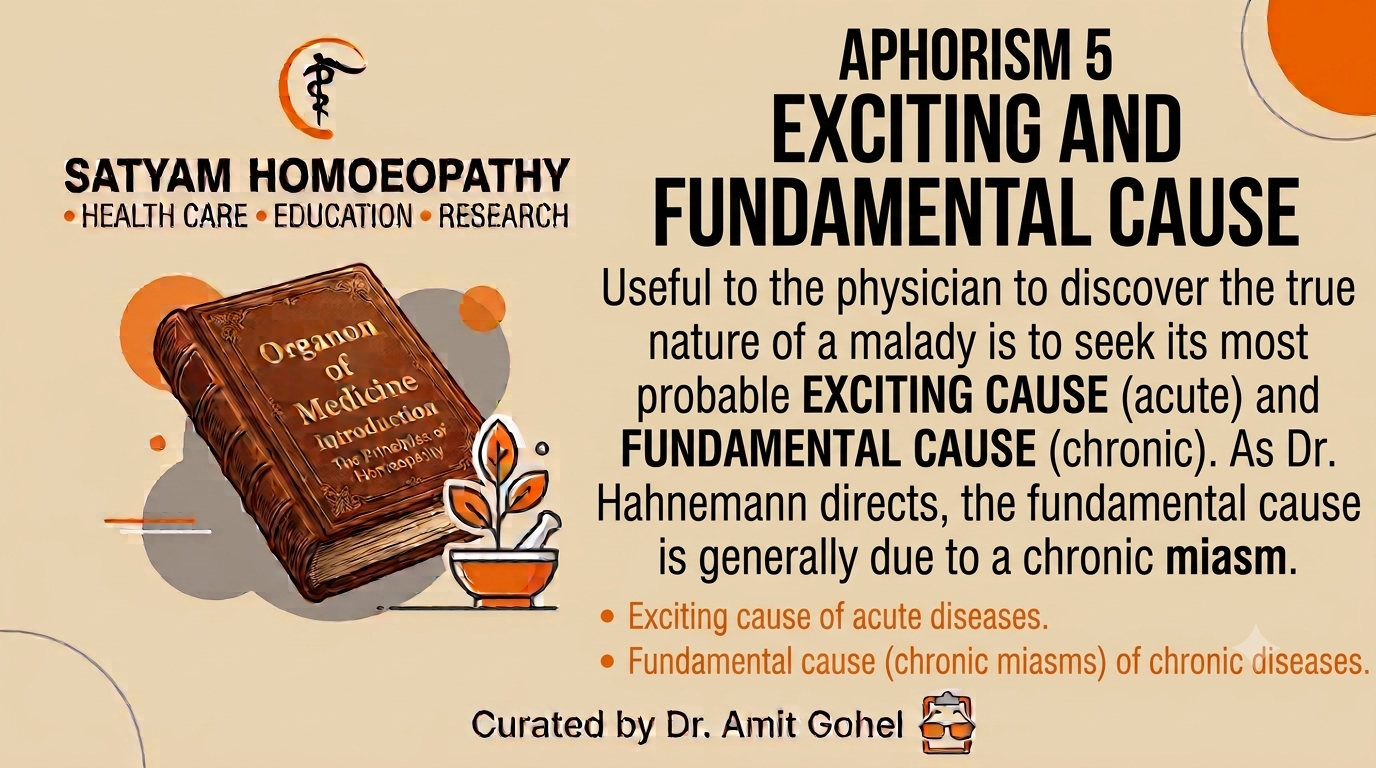
Aphorism 5:
The Detective Work of Healing: Aphorism 5 and the Search for Causes
Having established the physician’s mission to cure and the necessity of being a “preserver of health,” Samuel Hahnemann moves into the practicalities of diagnosis in Aphorism 5. If the previous principles provided the “what” and the “why,” this aphorism begins to explain the “how”—specifically, how a physician must investigate a patient’s life to uncover the root of their suffering.
The Two Types of Causes
Hahnemann distinguishes between two types of illness, each requiring a different investigative focus:
- Acute Diseases (The Exciting Cause): For sudden, rapid illnesses, the physician must look for the “exciting cause”. This might be a specific event or influence that triggered the sickness, such as “excesses in food,” “chills,” “over-heating,” “strains,” or sudden “mental emotions”.
- Chronic Diseases (The Fundamental Cause): For long-standing ailments, the physician must look deeper into the “most significant points in the whole history” to find the “fundamental cause”. Hahnemann asserts that these persistent diseases are generally rooted in what he terms a “chronic miasm”—an underlying infectious principle like psora, syphilis, or sycosis that the body cannot overcome on its own.
The Patient’s Biography as a Medical Tool
Aphorism 5 is famous for its insistence on individualization. Hahnemann argues that a physician cannot truly understand a disease without understanding the person who has it. He lists several “accessory circumstances” that must be meticulously investigated:
- Physical Constitution: The patient’s “ascertainable physical” build and strength.
- Moral and Intellectual Character: Their temperament and mental state, which Hahnemann believed were inseparable from physical health.
- Occupation and Habits: The patient’s “mode of living” and “habits,” which could include anything from a sedentary lifestyle to dietary errors.
- Social and Domestic Relations: The stressors or supports found in their “social and domestic relations”.
- Demographics: Vital statistics such as age and sexual function.
Uncovering the “Portrait” of the Disease
By gathering these details, the physician moves beyond a generic label (like “headache” or “fever”) to create a “true and only conceivable portrait of the disease”. This holistic view allows the practitioner to see how the “spirit-like (dynamic) derangement” of the vital force is manifesting uniquely in that specific individual.
Furthermore, identifying these factors helps the physician fulfill their duty as a “preserver of health” by identifying and removing “obstacles to recovery”—such as an unhealthy environment or injurious habits—that might otherwise extinguish the effects of even the most perfectly chosen remedy.
Conclusion: A Science of the Whole Person
Aphorism 5 transforms the medical exam from a brief check of symptoms into a deep biographical inquiry. It reminds us that in the healing art, there are no “standard” cases. By investigating the exciting and fundamental causes alongside the patient’s character and lifestyle, the physician gains a “sure guide” to the remedy that can restore health rapidly, gently, and permanently.

